Grocery Market Cashier Store
- 3.4
- Rating
- 10.00M
- Installs
- Free
- Price
 Analysis by App-foxy
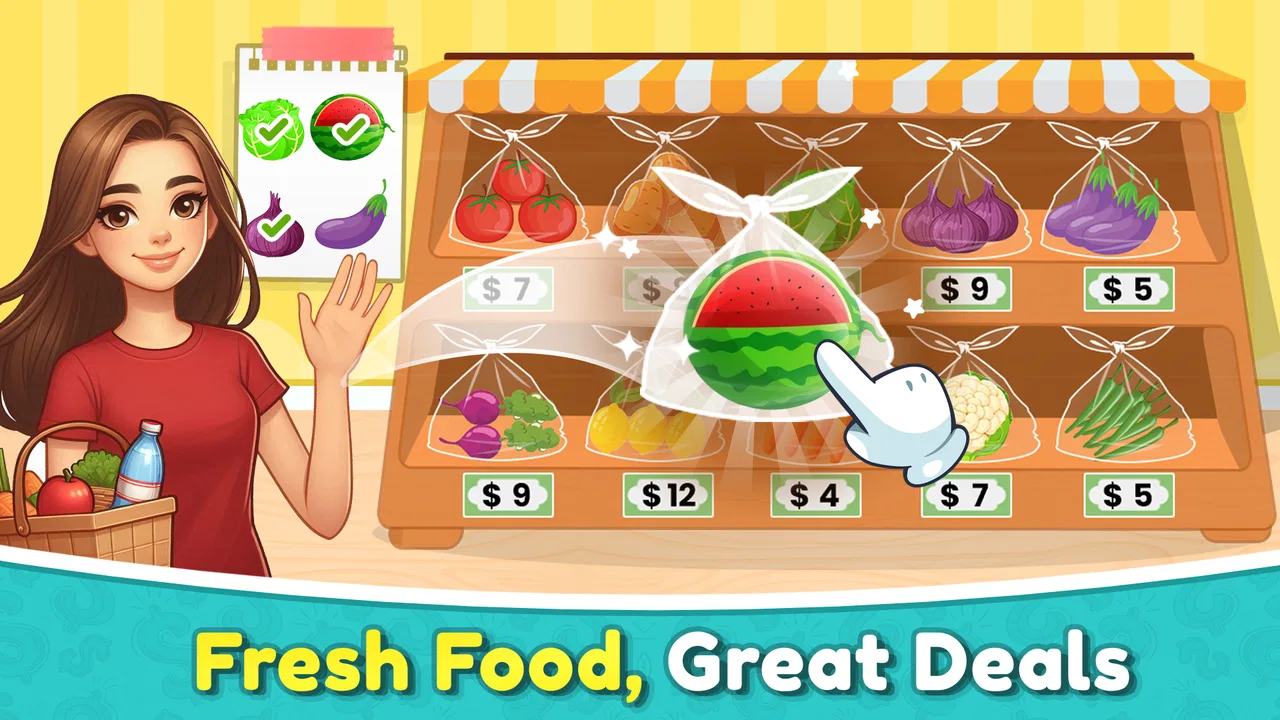
I found Grocery Market Cashier Store most useful when I treated it as a small practice tool rather than a full supermarket simulation. Developed by NutBolt Games, this free educational game puts the player behind a checkout counter and focuses on the basic actions involved in operating a cash register. Its central idea is simple, but that simplicity gives it a clear purpose: it can help a child become familiar with prices, totals, payment, and change without the pressure of a real queue.
That narrow focus is also the reason I would not recommend it to everyone. If you want a deep management game, a realistic shop-building experience, or a long campaign with varied objectives, this is likely to feel limited. If you want a straightforward way to introduce cashier routines through short play sessions, however, it has a practical charm. Its best quality is that it turns an everyday transaction into a basic learning exercise.
Learning the counter one transaction at a time
The game’s educational value comes from making the checkout process the main activity instead of hiding it inside a larger business game. I can imagine a younger player starting with the familiar setting of a grocery market, selecting or handling products, checking the amount due, and working through the payment stage. Even when the individual actions are uncomplicated, the sequence encourages attention: the player has to follow the order of a transaction rather than simply tap through a quiz.
You May Also Like

 Blood Strike: 2.5 Anniversary
Blood Strike’s Loadouts Turn Every Drop Into a Tactical Gamble
A close look at Blood Strike’s custom loadouts: how fast access to signature weapons reshapes its battle royale rhythm, rewards preparation, and narrows the gap between fights.

 Pandora - Music & Podcasts
Pandora’s Music Is Easy to Start, but Harder to Recover
Pandora’s strength is its low-effort path from a seed to a station. Its weak spot is how much confidence it asks you to place in connection, setup, and quiet recovery.

 8 Ball Pool
 Is Built on Rivalries, Rematches, and Routine
A close look at the rivalries, rematches, shared routines, and unanswered safety questions that turn a quick pool match into a persistent mobile community.

 Samsung Music
’s Quiet Strength Is Playing What You Already Own
Its reach comes less from spectacle than from dependable access to a personal library. That simplicity is both the app’s strongest retention engine and its ceiling.

 AccuWeather: Weather Radar
AccuWeather Review: A Quick, Clear Forecast for Everyday Decisions
For everyday plans, the best forecast is the one you can understand quickly. AccuWeather makes rain timing, radar, and local conditions easy to act on, with a few trade-offs.

 Hill Climb Racing
Why Hill Climb Racing Still Turns Crashes Into One More Run
A tiny car, a bumpy hill and one more upgrade: Hill Climb Racing keeps resurfacing because its simple chaos makes every near-miss feel personal.
More From Our News Desk
View All News


That makes it different from a conventional arithmetic app. A worksheet can ask for an answer, while a cashier game gives that answer a context. The player is not only solving a number problem; they are imagining why the number matters. A total is connected to a basket of groceries, and change is connected to money handed over by a customer. For children who lose interest in abstract sums, that setting can make practice feel more purposeful.
I also like the way the theme gives parents or teachers an easy conversation starter. After a session, an adult can ask why a customer receives a particular amount of change, how several prices were combined, or what should be checked before completing a sale. The game does not need to carry the entire lesson by itself. It works better as a prompt for discussion and repetition.
Grocery Market Cashier Store is listed as an educational game, and that description fits its practical direction. It is not trying to teach every part of retail work. Instead, it concentrates on the checkout counter, where counting, recognition, order, and careful tapping come together. I found that concentration more helpful than a cluttered design would have been, especially for a first introduction.
Why the grocery setting works
A grocery market is an approachable setting because most players have seen a checkout in daily life. A child may already understand that products have prices and that a customer pays before leaving the store. The game can build on that familiarity without requiring a complicated explanation of the world or its rules. This is one of its more effective design choices: the subject is ordinary, so the learning goal is easy to recognize.
There is also a useful difference between recognizing a coin or note and deciding what to do with it. A player can know the names of money values but still need practice calculating the difference between a total and a payment. A cashier-focused activity gives that difference a visible purpose. I would use it when a child understands basic numbers but needs more confidence applying them in a situation that resembles real life.
One practical routine would be a short session before a family shopping trip. The child could play for a few minutes, then help compare prices or count change during a supervised purchase. The real-world activity should remain the important part, but the game can make the transition less intimidating. It is especially suitable when the goal is familiarity rather than formal assessment.
Small habits that make the practice more useful
I would not leave a young player to tap through every transaction as quickly as possible. The better approach is to ask them to say the total aloud, identify the payment, and estimate the change before confirming it. That turns the game from a reaction test into deliberate practice. It also reveals whether the player understands the transaction or is simply following visual prompts.
Another useful habit is to pause after a mistake instead of immediately restarting. Ask what was counted incorrectly: the item price, the combined total, or the amount returned. These are different problems and need different kinds of help. A child who repeatedly misreads a price needs attention to recognition, while a child who knows the total but gives the wrong change needs subtraction practice.
I would also vary the pace. Some rounds can be completed slowly with an adult explaining each step, while others can be used for independent repetition. This matters because speed is not the same as accuracy. A cashier game can accidentally reward rushing if the player focuses only on finishing. Used thoughtfully, it can instead encourage a reliable sequence: check, calculate, pay, and verify.
What the experience does well
The strongest evidence in favor of the game is its immediate clarity. I do not need to learn a long backstory or understand a complicated control system before reaching the educational activity. The grocery-market theme tells me what kind of task to expect, and the cashier role gives each action a recognizable purpose. That makes it accessible for children who may be overwhelmed by larger simulation games.
It is also a reasonable choice for short practice. A parent looking for a quick activity does not necessarily need a game that occupies an entire afternoon. The checkout concept can be revisited in small sessions, which is often more useful for basic arithmetic than one long period of play. Repetition works best when it remains manageable, and this format supports that kind of routine.
The game’s age classification is Everyone, which matches the simple, family-oriented subject matter. I would still expect an adult to guide younger children, not because the theme is difficult, but because the educational benefit depends on how the player thinks through each transaction. A child may enjoy the role-play without noticing the calculation lesson unless someone occasionally draws attention to it.
It is free to play, making it easy to try without turning the decision into a financial commitment. That is useful for families who want to test whether a cashier activity holds a child’s attention before looking for more advanced educational software. The trade-off is that a free, focused game should be judged by the quality of its core lesson, not by expectations of a broad commercial simulation.
Where it falls short
The main weakness is limited depth. Once the basic checkout routine becomes familiar, a player may want more variety than the central concept provides. I would not choose it as a primary game for an older child who expects progression, strategy, customization, or a detailed store to manage. Its value depends on whether practicing the cashier task is still the objective.
There is also a risk of confusing tapping accuracy with financial understanding. A player might complete a transaction by recognizing the correct visual cue without being able to explain the calculation. That is not necessarily a flaw in the concept, but it means the game should not be treated as proof that a child has mastered money skills. I would pair it with spoken questions, written examples, or supervised shopping practice.
The focus on the register can feel narrow compared with broader alternatives in the educational category. A dedicated math app may offer more varied arithmetic exercises, while a larger shop simulation may include inventory, pricing decisions, customer service, and store planning. Those options are better when the learning goal is broad numeracy or business management. This game is more appropriate when the goal is specifically to rehearse the checkout moment.
Parents should also consider the difference between screen familiarity and real-world money handling. Digital transactions can be forgiving and visually guided, while physical coins and notes require recognition by shape, size, and value. I would use the game as a bridge, then move to real objects under supervision. That combination gives the child a chance to transfer the idea instead of keeping it inside the screen.
Who should install it
I think Grocery Market Cashier Store is best for younger learners who enjoy pretend-play roles and are beginning to connect numbers with everyday purchases. It can suit a parent searching for a simple activity, a teacher looking for a conversation prompt about money, or a child who finds a cashier counter more engaging than a traditional arithmetic exercise.
It may also help a learner who needs repeated exposure to the order of a transaction. Some children understand addition and subtraction in isolation but become uncertain when several steps appear together. The grocery setting provides a stable frame for practicing that sequence. I would keep sessions short and stop while the player is still attentive, since repetition becomes less productive when it turns into automatic tapping.
I would skip it if your priority is advanced mathematics, a detailed retail simulation, or a game with a strong long-term progression system. It is also not the right replacement for hands-on money lessons. Someone looking for a comprehensive educational suite will probably get more range from a broader alternative, even if that alternative lacks the specific cashier role this game presents.
Device compatibility is reasonably approachable for many users because the current version is 4.8 and it requires Android 8.0 or later. I would still check the device before installing, particularly on an older phone or tablet. The game has been available since Aug 14, 2018, and its continued presence suggests that the basic concept has remained relevant, but its appeal is tied to that focused concept rather than to being a new or expansive release.
How it compares with other learning choices
Compared with a standard arithmetic app, this game has stronger context and weaker breadth. A math-focused alternative may move from addition to subtraction, multiplication, fractions, or timed drills in a more systematic way. Grocery Market Cashier Store instead makes a smaller set of skills feel connected to a familiar responsibility. I would choose the cashier game for motivation and situational practice, then use a broader math tool when the child needs a structured curriculum.
Compared with a supermarket management game, it is easier to understand but less ambitious. Management games often ask players to think about stock, prices, upgrades, or customer flow. Those systems can be entertaining, but they may distract from the actual act of calculating a purchase. Here, the narrow role is an advantage for a first lesson and a limitation for anyone seeking a complete business experience.
Compared with role-play away from the phone, the game offers convenience and repeatability, while real objects offer better physical understanding. A homemade shop with empty food packages and play money can teach recognition and communication in a richer social way. The app is quicker to set up and easier to repeat independently, but I would not let convenience make it the only method.
Practical ways to get more from each session
For the first few sessions, I would focus on accuracy and vocabulary rather than speed. Have the player identify the total, describe the payment, and explain the change. If the game presents a choice, ask the child to predict the correct one before touching the screen. This simple pause makes the reasoning visible and helps an adult spot where support is needed.
For independent play, set a small goal such as completing a handful of careful transactions without guessing. The goal should be observable and realistic, not a demand to keep playing for a long time. Afterward, connect the activity to a real example: compare two grocery prices, calculate a small total, or count a modest amount of change together. The transfer is where the educational value becomes more convincing.
For an older learner, I would use the game as a warm-up rather than the whole lesson. Start with the cashier activity, then create a few spoken or written variations using everyday prices. This exposes whether the player can apply the idea when the screen no longer supplies the same structure. It also prevents the game from becoming a repetitive tapping exercise.
One subtle trade-off is that guidance improves learning but reduces the sense of independent play. If an adult explains every answer, the child may finish transactions successfully without developing confidence. If the adult never checks in, errors may become habits. I would provide hints as questions—“What is the total?” or “How much was paid?”—instead of giving the result immediately.
My final recommendation
Grocery Market Cashier Store earns its place as a focused educational game because it gives basic money practice a recognizable setting. NutBolt Games has chosen a subject that children can understand quickly, and the free format makes experimentation easy. With over ten million installs, it has clearly reached a broad audience, while its average rating of 3.4 from around nine thousand ratings suggests that expectations should remain measured rather than treating it as a universally satisfying game.
My recommendation is specific: try it if you want a simple cashier-themed activity for a young learner, especially when you are willing to talk through the calculations and connect them to real shopping. Do not install it expecting a deep supermarket world or a complete mathematics course. Use it as a practical starting point, not as the entire lesson.
For me, that is the fairest way to judge Grocery Market Cashier Store. It succeeds when its small scope matches the player’s need: understanding how a purchase moves from products to total, payment, and change. It becomes less convincing when the player has already mastered that routine or wants richer gameplay. As a free Everyone-rated game, it is worth trying for the right audience, provided an adult treats the screen activity as practice that should eventually lead back to real-world confidence.
FAQs for Grocery Market Cashier Store
01What is Grocery Market Cashier Store about?
Grocery Market Cashier Store is a casual supermarket simulation game in which you manage checkout duties and help run a virtual grocery shop. Players scan products, calculate purchases, handle payments, organize shelves, and complete customer-focused tasks. It is designed for users who enjoy simple time-management, retail, and role-playing gameplay with straightforward controls and short activities.
02How do you play Grocery Market Cashier Store?
The main gameplay revolves around serving customers at the supermarket checkout. You typically select or scan grocery items, check prices, total the bill, accept the correct payment, and return change when necessary. Depending on the version, you may also restock products, clean the store, unlock improvements, or complete objectives that gradually make the virtual market busier and more challenging.
03Is Grocery Market Cashier Store suitable for children?
The game is generally suitable for children and families because its mechanics are simple, nonviolent, and based on everyday shopping activities. However, parents should still review the age rating and store listing before installation, since advertisements, optional purchases, or data-collection practices can vary by device and app version. Younger children may also need help understanding in-game purchases.
04Does Grocery Market Cashier Store work without an internet connection?
Some basic supermarket and cashier activities may be playable offline after the application has been installed, but this can depend on the version and device. Internet access may still be required for advertisements, updates, cloud features, rewards, or in-app purchase verification. For the most reliable information, check the current Google Play or App Store description and test the game after temporarily disabling your connection.
05Is Grocery Market Cashier Store free to download?
Grocery Market Cashier Store is commonly offered as a free download, allowing users to try the core cashier and supermarket activities without paying upfront. Nevertheless, free versions may include advertising, optional in-app purchases, or progression systems that encourage additional spending. Before downloading, review the store page for the latest pricing, permissions, supported devices, and purchase-related details.
Pros
- Simple controls make the cashier tasks easy to learn.
- Bright visuals and playful presentation suit younger players.
- Short checkout activities work well for quick gaming sessions.
- Different grocery items add variety to each customer order.
- Offline play is convenient when no internet connection is available.
Cons
- Gameplay can become repetitive after completing several checkout rounds.
- Limited challenge may not satisfy players seeking complex simulation features.
- Ads may interrupt play or appear frequently between activities.
- Some content may feel too basic for older children or adults.
- Progression and rewards may offer little long-term motivation.

Grocery Market Cashier Store
Gallery